Minos 2009

The weekend followed its customary pattern with the Saturday consisting of a number of presentations from members of the community and Sunday giving an opportunity for folk to compete in the friendly, but earnest, competition session. The rest of this post has a summary of each speaker’s session and a link to the slides and other media where available.


(more…)

Continue ReadingMinos 2009

Minos 2009 – competition results

Sunday mornings at Minos sees our intrepid robot builders giving their creations a bit of friendly competition on a full size maze. Both wall-followers and maze solvers get to show what they are made of. The full-size maze is pretty big so everyone wants to make best use of the opportunity. Competing on the Sunday is an essential part of the run-up to the main competition in June. Here are the results for the  MINOS 09 event.

(more…)

Continue ReadingMinos 2009 – competition results

Ternary numbers for diagonal micromouse turns

by Alan Dibley

The translation of a route from one using 90 degree turns only to one using a combination of 45, 90 and 135 degree turns is not an obvious or trivial task. There are several possible approaches. this method recognises that there are only three kinds of action in an orthogonal route. Thus it seems to make sense to represent those values as a base three, or ternary, number. A simple translation process can then take these values as triplets and look up a translated move in a table.

(more…)

Continue ReadingTernary numbers for diagonal micromouse turns

USBasp on the Mac

IMG_3576The USBasp AVR programmer arrived today so I lost no time connecting it up to give it a try. This is a clever little beast that uses a software USB stack on a pre-programmed ATMEGA8 processor. It works directly with AVRdude to program your target processor with the minimum of fuss.
(more…)

Continue ReadingUSBasp on the Mac

AVR, Eclipse and the Mac

eclipse_home_header.jpgAVRMacPack works well enough in Xcode but I don’t understand Xcode so I wen looking for an alternative. While trawling through back issues of SERVO magazine, I came across a pair of articles by Dennis Clarke about setting up Eclipse with AVRMacPack and the avr-eclipse plugin. One of my recurring mistakes is the feeling that you can’t have enough development tools so I gave it a go…
(more…)

Continue ReadingAVR, Eclipse and the Mac

AVRMacPack and Xcode

6D1EDDCC-B888-4629-8116-6E8F9EC6D483.jpgThe AVRmacpack for AVR development on the Apple Mac contains command line tools. These are all well and good if you want to do things the traditional way with text editors, terminal windows and make files. No real problem. However, if you want the benefits of a modern IDE with things like function lists and refactoring, you might want to try Xcode. It is, after all, supplied with your Mac.
(more…)

Continue ReadingAVRMacPack and Xcode

AVR on a MAC: Blinky success

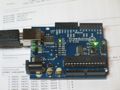
freeduino-1.jpgAs a first step, the blinking of an LED is an essential part of development for a new processor and environment. I had read somewhere that the bootloader on an arduino was compatible with an avrisp/STK500 programmer. That turns out to be quite right!

(more…)

Continue ReadingAVR on a MAC: Blinky success

AVR on the MAC

7C0C36AB-CBD4-4652-9631-C533CE111905.jpgAfter many hours playing with the new iMac, it is time to get something ‘proper’ done with it. By proper, I mean, of course, some microcontroller development. To start with, I have been looking at the AVR.

 
(more…)

Continue ReadingAVR on the MAC

A new day dawns

After several weeks playing with a MacBook, I have become a bit of a Mac convert. Not only are the machines very pleasing and the operating system a relative delight to use, I can also run Windows on it for that 'best of both worlds' experience.

Continue ReadingA new day dawns

RoboTIC 2008

IMG_3295Our winter event is RoboTIC, hed at the Technology Innovation Centre in Birmingham. This year we gathered on Saturday 29th November and held the usual semi-formal set of competitions…

(more…)

Continue ReadingRoboTIC 2008